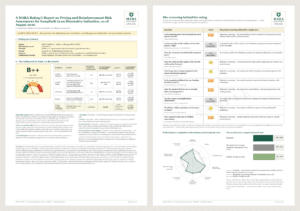
What payers will ask
Is the clinical benefit the kind payers reward? — Clinical effectiveness
The clinical evidence from the TOPAZ-1 trial indicates a moderate benefit of durvalumab plus gemcitabine and cisplatin over standard treatment, with an increase in median overall survival from 11.3 months to 12.9 months and median progression-free survival from 5.7 months to 7.2 months. However, the lack of a reported p-value for overall survival and the noted limitations in the proportional hazard assumption suggest that while there is a benefit, it is modest.
Does the economic case hold at the expected price? — Cost effectiveness
The cost-effectiveness estimates for durvalumab plus gemcitabine and cisplatin are reported to be below £30,000 per QALY gained, which is within NICE’s acceptable threshold. The committee acknowledged the uncertainty in the estimates but concluded that they are defensible given the high unmet need in this patient population.
Is there quality-of-life evidence payers weigh? — Quality of life
The use of the EQ-5D-5L questionnaire in the TOPAZ-1 trial indicates that patients receiving durvalumab plus gemcitabine and cisplatin experience improved health-related quality of life. The committee recognized the severity of biliary tract cancer and the potential for significant quality-of-life improvements, although some uncertainty remains regarding the utility values derived from the trial data.
Does the safety profile hold up for payers? — Safety and Adverse Effects
The safety profile of durvalumab plus gemcitabine and cisplatin is considered very good, with manageable adverse events. The clinical experts noted that durvalumab is better tolerated than standard chemotherapy regimens, which typically have more severe side effects. This suggests a favorable safety profile compared to existing treatments.
Was the drug compared against what payers expect? — Comparator Selection
The comparator, gemcitabine plus cisplatin, is the established standard of care for unresectable or advanced biliary tract cancer. The committee confirmed that this was the most relevant comparator, and the evidence supports the appropriateness of this choice.
Is the population defined the way payers need it? — Patient Population and Subgroups
The trial population in TOPAZ-1 is considered to be representative of the intended patient population for durvalumab plus gemcitabine and cisplatin. The committee noted that while there are some concerns regarding age differences, the majority of patients in the trial had an ECOG performance status of 0 or 1, which aligns with the typical patient population.
Does the drug fit how care is delivered and paid for? — Care Pathway Integration
Durvalumab plus gemcitabine and cisplatin can be integrated into existing treatment pathways without significant disruption. The committee noted that no new infrastructure or extensive training is required, making it a seamless addition to current clinical practice.
Are the wider system costs understood? — Resource Use and Cost Implications
The economic model indicates that the resource use associated with durvalumab plus gemcitabine and cisplatin is manageable within the Healthcare budget. The committee concluded that the treatment is resource-efficient, especially considering the potential for improved outcomes.
Would the evidence survive payer scrutiny? — Evidence Quality and Robustness
The evidence base is supported by a robust Phase 3 RCT (TOPAZ-1) with a substantial sample size. While there are some methodological concerns, the overall quality of the evidence is strong, and the trial data is deemed credible for decision-making.
How exposed is the case to uncertainty? — Uncertainty, Sensitivity, and Broader Impacts
While there is some uncertainty regarding the long-term outcomes and cost-effectiveness estimates, the committee noted that the treatment addresses a significant unmet need in a severe disease context. The overall societal context is supportive of the treatment’s use.