
MARA Rating — Back-test series, June 2026
We built MARA to answer one question before the decision arrives: given this evidence profile, how have HTA bodies historically responded to assets like this one?
That question only has value if the answer is testable. So we tested it.
This post documents the first systematic back-test of MARA ratings against completed HTA decisions. Nine drugs. Three countries. Three agencies. Ratings written between March 2023 and February 2026 — all compared against decisions that came after.
What we compared, and what we excluded
Nine drugs cleared our pre-flight checks and entered the back-test. Two additional cases were excluded before scoring began.
One was excluded because the MARA rating was written on the same day the relevant ICER assessment was published — and the scorecard explicitly cited ICER cost data as an input. That is not a prediction. It is a concurrent evaluation. We excluded it, documented the reason, and added a rule to our comparison workflow to catch this pattern in future.
The second was excluded because the HTA opinion in question was a packaging registration, not a clinical evaluation. HAS occasionally publishes opinions on new presentations of already-reimbursed products. These carry no predictive value for MARA and are not comparable to a clinical access decision.
Both exclusions were flagged proactively, before any comparison was attempted. Methodological honesty is the basis on which these results are interpretable at all.
The nine assessable cases covered NICE in the UK, the G-BA in Germany, and HAS in France. Therapeutic areas included haematology, nephrology, oncology, dermatology, and neurology. MARA grades tested ranged from A (Strong) to B+ (Very Weak).
The results
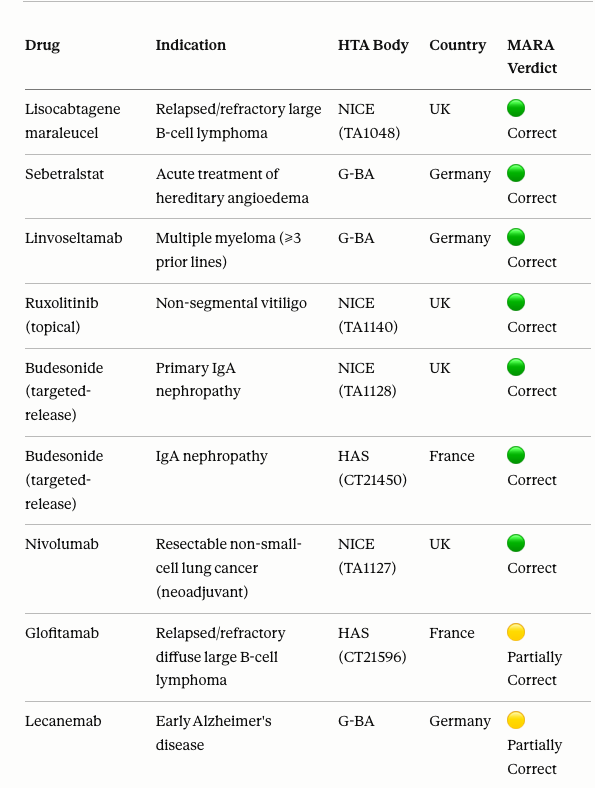
Seven Correct. Two Partially Correct. Zero Incorrect.
Across all nine cases, the MARA grade pointed in the right direction. Every drug rated A (Strong) received a positive access outcome — recommended or reimbursed, with or without conditions. Every drug rated below A sat in territory where the actual decision reflected uncertainty or structural constraint.
The B+ (Very Weak) rating on linvoseltamab translated directly into No Additional Benefit at the G-BA. The B++ (Marginal) on ruxolitinib cream correctly predicted a conditional recommendation at NICE. The B++ on lecanemab correctly placed the drug at the reimbursement margin — a zone where outcomes depend on how evidence is interpreted and how the comparator question is resolved.
Directional accuracy: 100% across nine assessable cases.
Overall accuracy — including domain-level alignment and pricing signals — was 78%.
The table below shows each comparison in full.
What we missed
Two cases were scored Partially Correct. Both are worth explaining in detail, because the reasons are instructive.
Glofitamab. MARA rated it A (Strong), based on clinical evidence from the STARGLO trial — a Phase 3 combination regimen. HAS evaluated glofitamab as a monotherapy, using Phase 2 data. That is a structurally different evidence package, and it produced a different result at the pricing level. HAS assigned SMR Important (confirming reimbursement) — the direction MARA predicted. But HAS also assigned ASMR V, where MARA’s historical pricing signal had suggested an advantage was more likely.
The miss was not a model error. MARA and HAS were not assessing the same evidence. The access direction held. The pricing call did not, because the clinical differentiation argument that might have supported a better ASMR was built on a trial that HAS did not consider its primary reference. We have updated our workflow to explicitly cross-check which evidence package each agency evaluates before running a HAS comparison.
Lecanemab. MARA rated it B++ (Marginal) — the correct designation for a drug at a reimbursement inflection point, where evidence quality and comparator interpretation determine the outcome. The G-BA signal was neutral by historical record: 50/50. The actual outcome was No Additional Benefit in both assessed subgroups — the negative end of the uncertainty range.
B++ correctly identified the risk. The outcome landed where MARA said it could land. Calling this a miss requires acknowledging that a model expressing genuine uncertainty, and an outcome that resolves at the negative end of that uncertainty, is not the same as a model that was wrong.
What this means
A nine-case back-test is not a validation study. The sample is too small for statistical claims, and we are not making any.
What we are claiming is narrower and, we believe, more useful: when MARA rated these nine drugs, the predicted direction matched the actual HTA outcome every time. Where the verdict fell short of a clean Correct, the reason was traceable — not random noise. Both partial misses had identifiable, structural explanations that a reviewer could verify independently.
That traceability is the core of what MARA offers. Not certainty. Not a single number that replaces judgment. A signal that is calibrated to observed payer behavior, applied consistently, and explainable when the outcome differs from what was predicted.
Internal forecasts have a structural problem: they are produced by the teams most invested in a positive result. That is not a criticism of those teams — it is how any organization works when stakes are high and timelines are short. An external benchmark that applies the same framework to every asset, regardless of who sponsors it, produces a different kind of input. One that a board, an investment committee, or an HTA body can scrutinize without first asking who built it and why.
Market-access risk is consistently under-weighted in early decisions. These nine comparisons do not change that. But they do make the case harder to dismiss.
What comes next
We will continue publishing comparisons as decisions come in. The methodology is documented. The exclusion criteria are explicit. Every verdict — Correct, Partially Correct, or Incorrect — will be published with its rationale and the underlying domain-level analysis.
Explore lisocabtagene maraleucel (Breyanzi) independent assessment: https://mararating.com/report/lisocabtagene-for-treating-relapsed-or-refractory-large-b-cell-lymphoma-after-first-line-chemoimmunotherapy-when-a-stem-cell-transplant-is-suitable-as-of-march-2025-market-access-risk-assessment/
Explore budesonide (Kinpeygo) independent assessment: https://mararating.com/report/kinpeygo-budesonide-for-treating-primary-iga-nephropathy-as-of-october-2025/
Explore glofitamab (COLUMVI) independent assessment: https://mararating.com/report/glofitamab-for-treating-relapsed-or-refractory-diffuse-large-b-cell-lymphoma-as-of-december-2025/
Explore nivolumab (Opdivo) independent assessment: https://mararating.com/report/nivolumab-for-neoadjuvant-treatment-of-resectable-non-small-cell-lung-cancer-as-of-march-2023-market-access-risk-assessment/
Explore lecanemab (Leqembi) independent assessment: https://mararating.com/report/lecanemab-for-treating-early-alzheimers-disease-as-of-september-2025-market-access-risk-assessment/
Explore linvoseltamab (Lynozyfic) independent assessment: https://mararating.com/report/linvoseltamab-gcpt-for-relapsed-or-refractory-multiple-myeloma-after-at-least-four-prior-lines-of-therapy-as-of-february-2026/
Explore sebetralstat (Ekterly) independent assessment: https://mararating.com/report/ekterly-sebetralstat-for-treating-acute-attacks-of-hereditary-angioedema-as-of-february-2026/